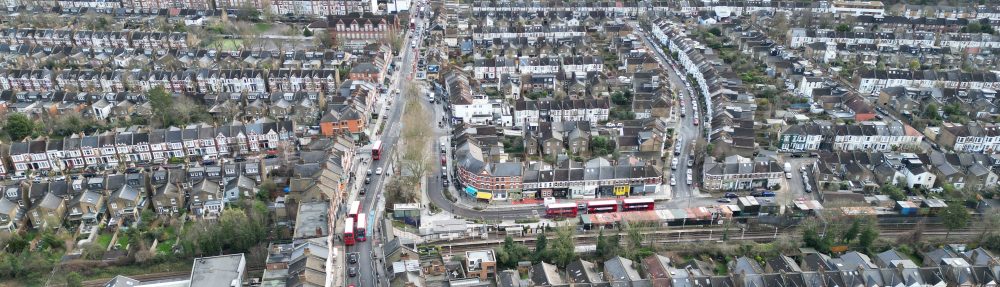
A wave of controversy has swept through Queen’s Park Ward (Kensal Rise and Queen’s Park area) this week following Brent Council’s launch of a consultation – quickly rebranded as a “survey” after resident backlash – regarding proposed traffic changes in just the Queen’s Park area.
The survey, for which the response deadline was also changed and extended to 6 December 2024, is being managed by MP Smarter Travel, the Council’s appointed consultants for this project.
The proposals aim to create a “healthy neighbourhood”, otherwise known as a Low Traffic Neighbourhood (LTN), through various road closures, with implementation timings to be determined through public input. See project area in the following graphic.

The Council has put forward two options (Option A and Option B) for the scheme, both of which have been criticised as draconian in nature, and absent of evidence and data-driven decision making. Under either option, residents of Kensal Rise and local businesses would be prohibited from travelling through the Queen’s Park area at certain times of the day. Meanwhile, residents of the Queen’s Park area would retain unrestricted access to Kensal Rise at all times, creating what many see as a two-tier system of access.
Alternative Queen’s Park Ward-Wide Approach
The Kensal Rise Residents’ Association (KRRA) has advocated for a more comprehensive approach, previously submitting proposals to the Council and Councillors that would reduce traffic across the entire Queen’s Park ward. Following intensive lobbying by the KRRA and recent public backlash, the Council last week announced that funding has been found to explore “congestion reduction” measures for Chamberlayne Road, with investigations to begin in early January.
However, the KRRA warns that these proposed measures may prove inadequate. With Chamberlayne Road already operating well above capacity, implementing “congestion reduction” measures alone would be futile without addressing the fundamental issue of excessive traffic volumes.
Further, as a boundary road for the proposed LTN scheme, Chamberlayne Road’s existing traffic will most likely increase due to expected traffic displacement arising from the proposed road closures. However, the Council, who hasn’t undertaken an impact assessment to understand potential traffic displacement, says this will not happen, when evidence from similar schemes implemented elsewhere in London show otherwise.
Understanding the Context
The Council’s current proposal seeks to extend existing traffic restrictions to additional roads in the Queen’s Park area, reportedly to address traffic displacement from earlier traffic restrictions implemented on some roads around the park. However, this approach has drawn significant criticism from residents across the ward.
The Chamberlayne Road Puzzle
Perhaps most contentious is the notable absence of any proposals for Chamberlayne Road, despite compelling data showing it should be a priority:
– Highest collisions in the Queen’s Park Ward – 40 between 2020 and 2022
– Illegal air pollution levels, particularly affecting schools and Station Terrace residents
– Heavy traffic volumes, with 60% originating from outside Brent Borough
– Chronic issues with rat-running
Evidence vs Implementation
The KRRA, Kensal Rise residents and the local business community have expressed serious concerns about this oversight. The data presents a stark contrast: while Chamberlayne Road faces significant challenges, the Council’s focus has shifted to implementing a healthy neighbourhood scheme in the Queen’s Park area where for 99% of streets in the project coverage area:
– Air quality levels are already well below illegal limits

– Road collisions are minimal
– Traffic volumes are low
Community Division Concerns
This apparent disconnect between evidence and action has sparked intense debate across local WhatsApp groups, school gates, and street conversations. Many residents argue that this approach risks dividing the community and reinforcing perceptions of inequality within the Queen’s Park Ward, “A Ward of Two Halves”.
A Call for Evidence-Based Decision Making
As a ward funded by taxpayers’ money, decisions should be:
– Driven by data and evidence
– Transparent in their reasoning
– Aligned with values of fairness, equality, and unity
– Independent of socioeconomic influence
The growing concern is that current proposals may prioritise the voices of more privileged residents over evidence-based solutions that benefit the entire community. As this consultation process continues, residents are calling for a more equitable approach that addresses the ward’s most pressing traffic and safety issues based on clear data rather than social influence.
The Way Forward
The entire Queen’s Park ward, Chamberlayne and Salusbury roads in particular, urgently needs measures that will protect vulnerable road users – cyclists, pedestrians, and particularly schoolchildren – while creating a healthier environment and safer streets that serve the many, not just a select few.
Have Your Say.
1. **Complete Brent Council Survey by 6 December 2024** Note you have 4 options, including “Do Nothing”
https://forms.monday.com/forms/380da15880e467d9465c26e7bd7bc40d?r=use1
3. **If You Wish, Sign the Resident Led Petition Opposing the Scheme
https://bit.ly/QueensParkTrafficPetition
3. **Review Proposal Details and Map**
Proposed scheme / project area within purple boundary
4. **Watch Video on Two Options**
Option A: https://bit.ly/QueensParkTrafficPetition
Option B: https://www.youtube.com/watch?app=desktop&v=kxRIifDOuN8&feature=youtu.be
5. **Join WhatsApp Group Conversation**
https://chat.whatsapp.com/ByCZ6dsvSnUH9sX6V7GOwX
6. **Share Feedback**
Email: kensalrisera@gmail.com
 Kensal Rise Residents' Association